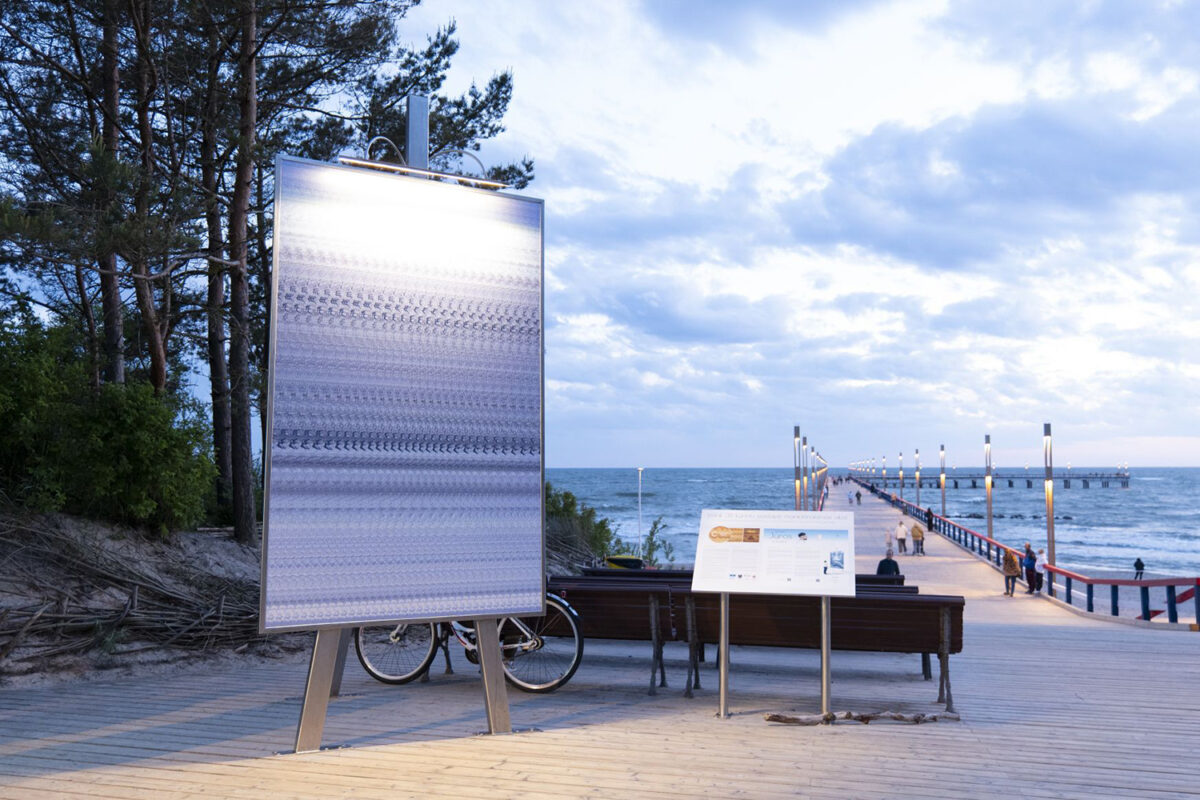
The largest autostereogram in Lithuania – measuring 2.5 metres in height and 1.6 metres in width – is the artwork “Three-Dimensional Sea Sonata”, created by graphic designer Loreta Roževičiūtė-Elksnė together with the creative group “Vėjo Rožė”. This spatial artwork is printed on a metal plate and was publicly presented for the first time on 1 June 2025. It is displayed on a 3.5-metre-high easel near the Palanga Sea Bridge. The artwork is unique in that it appears as a two-dimensional ornamental pattern, yet when the viewer focuses their gaze into the distance—looking “through” the flat ornament as if it were not there—and then slowly steps back, three-dimensional images emerge. These spatial images are reinterpretations of several paintings by M. K. Čiurlionis.
The arrangement of the ornamental patterns resembles the painting “Sonata – Allegro”, while the visible three-dimensional image echoes elements from “Sonata – Andante”: a ship held in the palm of a hand and two lighthouses in the distant sea. The artwork was created to commemorate the 150th anniversary of the birth of M. K. Čiurlionis and was developed over the course of one year.
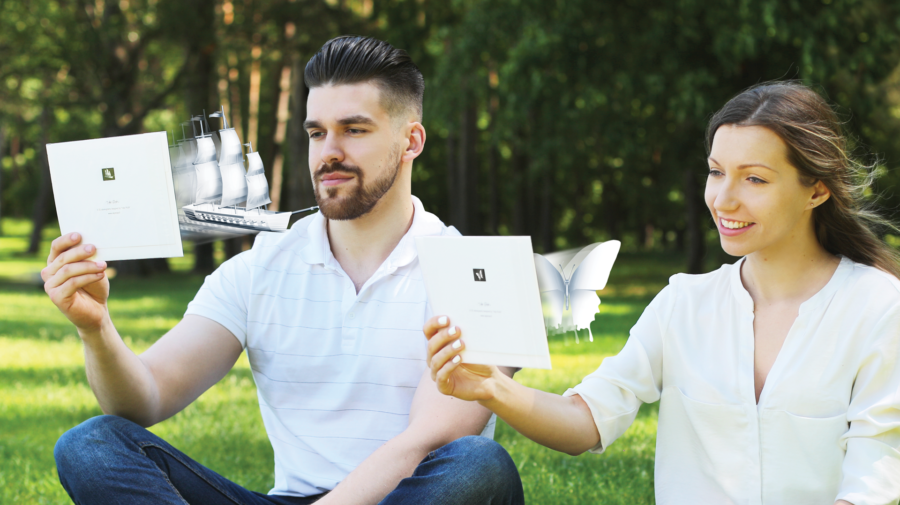
An autostereogram is often simply called a stereogram or a spatial image. It requires extremely meticulous manual work, as the ornamental patterns are drawn by hand, while the three-dimensional image is created in collaboration with a sculptor to achieve a precise sense of depth.
This distinctive form of artistic expression combines art and science. The spatial image is based on anatomical calculations of human vision, which is why the artwork cannot be enlarged or reduced. Viewing an autostereogram has a positive effect on eyesight: directing the gaze into the distance helps the eyes relax, while the “near–far viewing” exercise strengthens the eye muscles.
Next to the artwork, an informational stand explains how to correctly perceive the three-dimensional image, and M. K. Čiurlionis’ poem “The Sea” is presented alongside it, enriching the artistic narrative.
An identical-sized version of the artwork printed on canvas will be publicly exhibited in autumn 2025 at the M. K. Čiurlionis Art Gallery in Chicago (USA).
Graphic designer Loreta Roževičiūtė-Elksnė first became interested in the art of stereograms in 1995, when she visited an exhibition of spatial artworks brought from abroad in Kaunas together with her parents. Fascinated by the three-dimensional images, the future artist began exploring this field and tried to learn how to create autostereograms herself. At the time, however, stereogram masters did not share their methods. Over the years, Roževičiūtė-Elksnė developed her own creative techniques, and stereogram creation became her leisure-time passion. Remarkably, while viewing her early experimental works, the artist’s grandmother experienced an improvement in her eyesight, which became a strong motivation to further develop this artistic direction. As a result, in 2014 the designer brought together more professional designers and formed a creative group named “Vėjo Rožė”. Her husband Vaidas also became a member of this creative group.
Source: Lietuvos išskirtinių pasiekimų tarnyba, prepared by Vytautas Navaitis: The largest autostereogram